

Imagining L.A. Wine

Updated: Apr 19
A few years ago, I'd been researching a public-history project about L.A.'s first truly dominant industry, that of winemaking, when I realized that I’d been running across quite a lot of open and obvious bias against Los Angeles terroir.

This bias results from what I'll call a Northern California wine imaginary that views L.A., its past as well as its present, through the smoggy lens of its post-war, car-first history. According to this imaginary, the wine industry left Los Angeles, where it had been since the days of the Spanish missions, because it had found superior terroir in Sonoma and Napa Valley.
But if the terroir were of such inferior quality, how then could Los Angeles have become the epicenter of the first California wine industry? Well, for starters, landowners here had the benefit of lots of free Indigenous labor. But this wasn’t unique to Los Angeles. The padres in San Francisco had slaves, too. But no matter how many they had, they still couldn’t get the heat-seeking Spanish grapes to mature in the chilly, fog-bound city.

No, what made Los Angeles successful in wine-growing was that it had the perfect terroir for the sun-loving varieties that the padres brought with them from Spain. One can imagine how filled with hope these early settlers must have been when they first came upon the hot, dry growing conditions of Los Angeles, so similar to those in many of the best areas in the country they’d left behind – places like La Mancha, home of the Airen grape, which was used mainly for Brandy de Jerez; or inland parts of nearby Alicante, whose Palomino Blanco and Pedro Ximenez grapes were used for Sherry, or Andalucia, whose Muscat of Alexandria made the sweet wine called Malaga, and which today grows still at San Gabriel Mission in the L.A. suburb of Alhambra.
So we see there really was no problem growing grapes in Los Angeles, and of the finest quality, from what we read in accounts of the time. But the imaginary of inferior terroir has persisted, and while there are many factors that helped build it over time, the one that I find isn't talked about much is part of a larger story, one that goes back centuries, to the struggle for empire and cultural supremacy between Catholic Spain, whose winemaking traditions had remained more or less intact since Roman times, and Protestant England, which didn’t make wine but revered what it considered the superior, more modern winemaking techniques of France, Germany and a few other areas of better-watered Europe. And in those days what England drank mattered.
But if it wasn’t the terroir that caused the California wine industry to leave Los Angeles, then what was it? Again, there were a host of reasons, but the main one, the economic one, was land. Or rather, the price the land was able to fetch after the arrival of the transcontinental railroad in 1876. So the vineyards were sold off for housing, office and industrial subdivisions. In the process, a centuries-old, site-specific Spanish viticulture was destroyed and, more importantly, erased from memory.
The other day, I was down by the river, participating in one of the frequent clean-ups organized by Friends of the Los Angeles River. As we pulled plastic bottles and other detritus from the caked mud and plant life, a refreshing breeze from the San Gabriel Mountains kicked up, passing through the Glendale Narrows and embracing us all, as if its spirit approved of our efforts to reverse years of environmental degradation.
I took off my hat, wiped the sweat from the back of my neck and sat under a willow. There was a red-winged blackbird calling out from a nearby cottonwood, and as I listened, trying to decipher its song, the sound of passing cars faded into the background. I looked down-river, toward the city, and let the heat ripples play with my imagination.
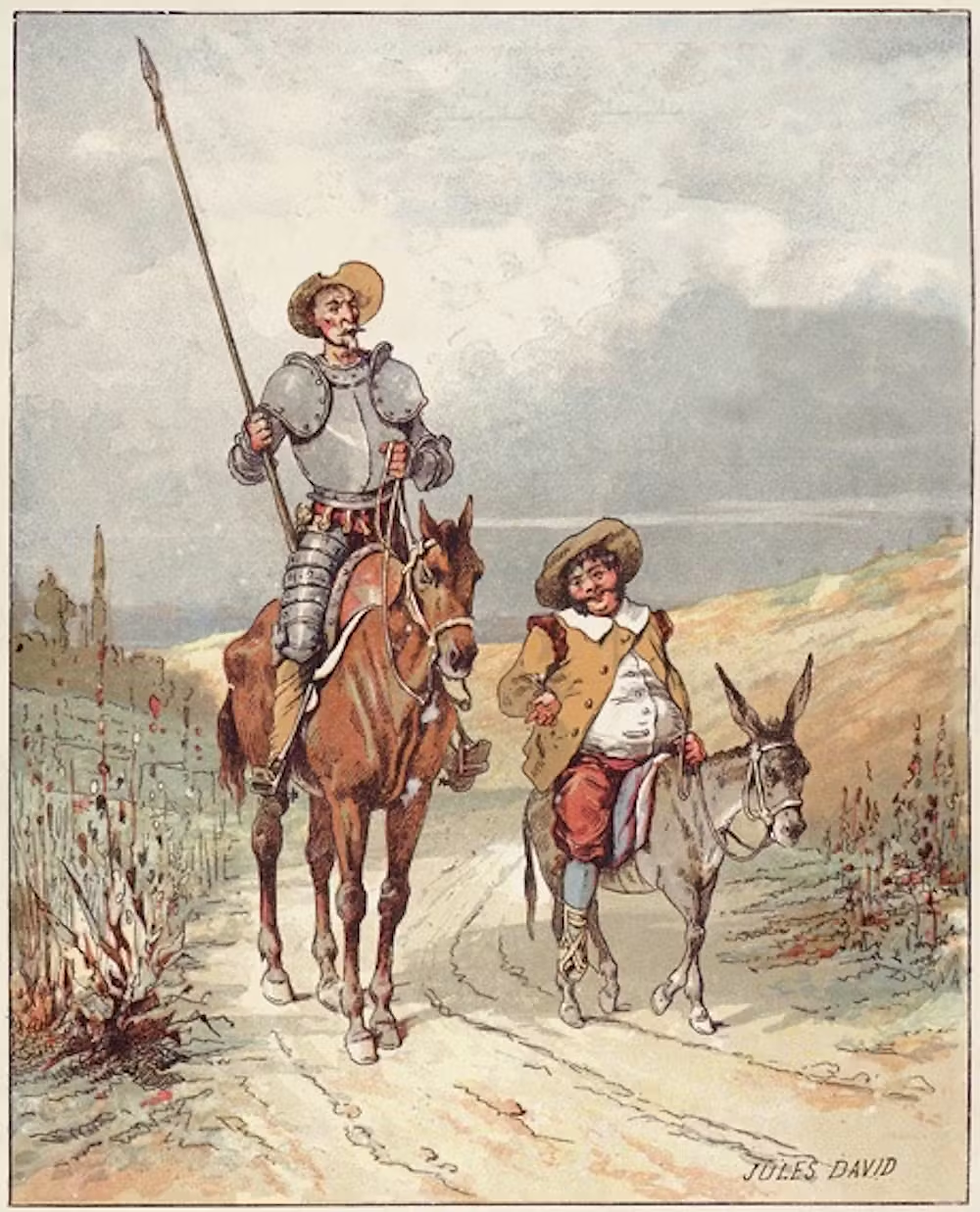
I thought of Don Quixote and Sancho Panza, that unlikely duo of La Mancha, and became convinced that if they had happened upon Los Angeles in the late 1700s, they might well have felt right at home, pitching their tienda along the river bank and drinking the local version of Brandy de Jerez.


Interesting hidden history. Keep doing the good work you started, Ned.
Much of the grape growing in Southern California was also table grapes in Burbank and wine out in cucamonga and Rialto
https://www.reddit.com/r/RareHistoricalPhotos/comments/1geebzh/burbank_california_celebrating_the_harvesting_of/